
1
/
of
1
Blue Vase Books
ORGANIC CHEMISTRY: A SELF-STUDY PROGRAM
ORGANIC CHEMISTRY: A SELF-STUDY PROGRAM
Regular price
$74.40
Regular price
Sale price
$74.40
Unit price
/
per
In stock
Couldn't load pickup availability
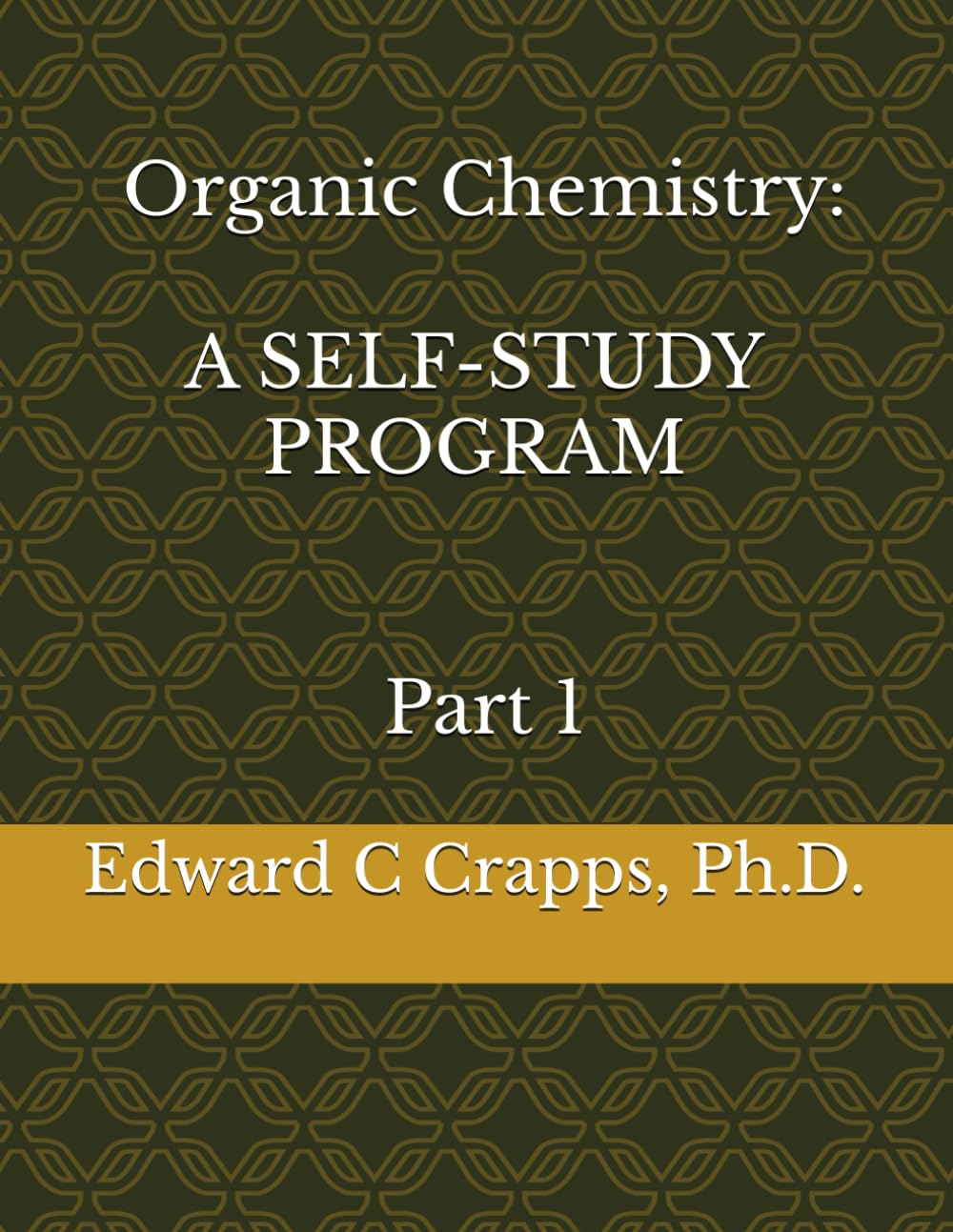
Organic Chemistry is not a subject that one should attempt to memorize; organic chemical reaction schemes are too complex for that. Students must know how to use key scientific principles such as Lewis Acid-Base Theory. My book is entitled Organic Chemistry: A Self-Study Program; it teaches reaction theory based on the reactivity of functional groups. The functional group of alcohols is the OH group, which is called the hydroxyl group. The OH group of alcohols reacts differently from the carbonyl group of aldehydes and ketones. That is, alcohols proceed by nucleophilic substitution reactions, which can be an SN1 or an SN2 reaction. On the other hand, the carbonyl group of aldehydes and ketones proceeds by nucleophilic addition. Each type of functional group proceeds by its own type of mechanism depending on the reaction conditions. Student must practice writing mechanisms; they are essential for grasping organic chemistry as opposed to memorizing it. My book shows students how write mechanisms by provide many illustrated examples for each functional group. A mechanism is a step-by-step reaction process that proceeds from reactants to product. It shows the movement of electrons in the reactants as they proceed to product(s) in a stepwise process, memorization is not needed. For example, the carbonyl group (C=O) in ketones and aldehydes react similarly, but their reactivity is based on inductive effects of the groups attached to the carbonyl group. The attached substituents to the C=O can be electron donating or electron withdrawing. In short, the carbon atom of the carbonyl is attacked by nucleophiles; this is called a nucleophilic addition reaction. The resonance structures of ketones and aldehydes are used to determine the reactive site in carbonyl compounds; there is a charge separation of the carbon-oxygen double bond (C=O) → (+C-O-). The carbonyl group is polarized; the carbon atom carries a positive charge; the oxygen atom carries a negative charge. The oxygen atom bonds with positively charged electrophile such as a proton. The positive carbon atom is attacked by nucleophiles such as a hydride or Grignard reagent. My book, Organic Chemistry: A Self-Study Program, teaches students how to jot down key information, which is a form of storytelling; it is the most powerful study strategy of all.
ASIN: B0D4LJXJPQ
VSKU: BVV.B0D4LJXJPQ.VG
Condition: Very Good
Author/Artist:Crapps Ph.D., Edward C
Binding: Paperback
Note: Any images shown are stock photographs and product may differ from what is shown.
Condition Notes: Book has little sign of wear or use
ASIN: B0D4LJXJPQ
VSKU: BVV.B0D4LJXJPQ.VG
Condition: Very Good
Author/Artist:Crapps Ph.D., Edward C
Binding: Paperback
Note: Any images shown are stock photographs and product may differ from what is shown.
Condition Notes: Book has little sign of wear or use
SKU:BVV.B0D4LJXJPQ.VG
Please Note: Gift cards that are purchased in-store, cannot be used online. These must be used in-store.
Shipping & Local Pick Up
Shipping & Local Pick Up
Shipping: Most orders are shipped within 24 hours. Please allow 4-14 days after the item has shipped for delivery. Faster shipping is available for purchase at checkout.
Local Pick Up: Orders will be available for pick up within 24 hours. Pick up at the front desk Thursday-Sunday 10am-6pm .After hours pick ups are available Monday-Wednesday 7am-3pm at the Shipping & Receiving entrance.