
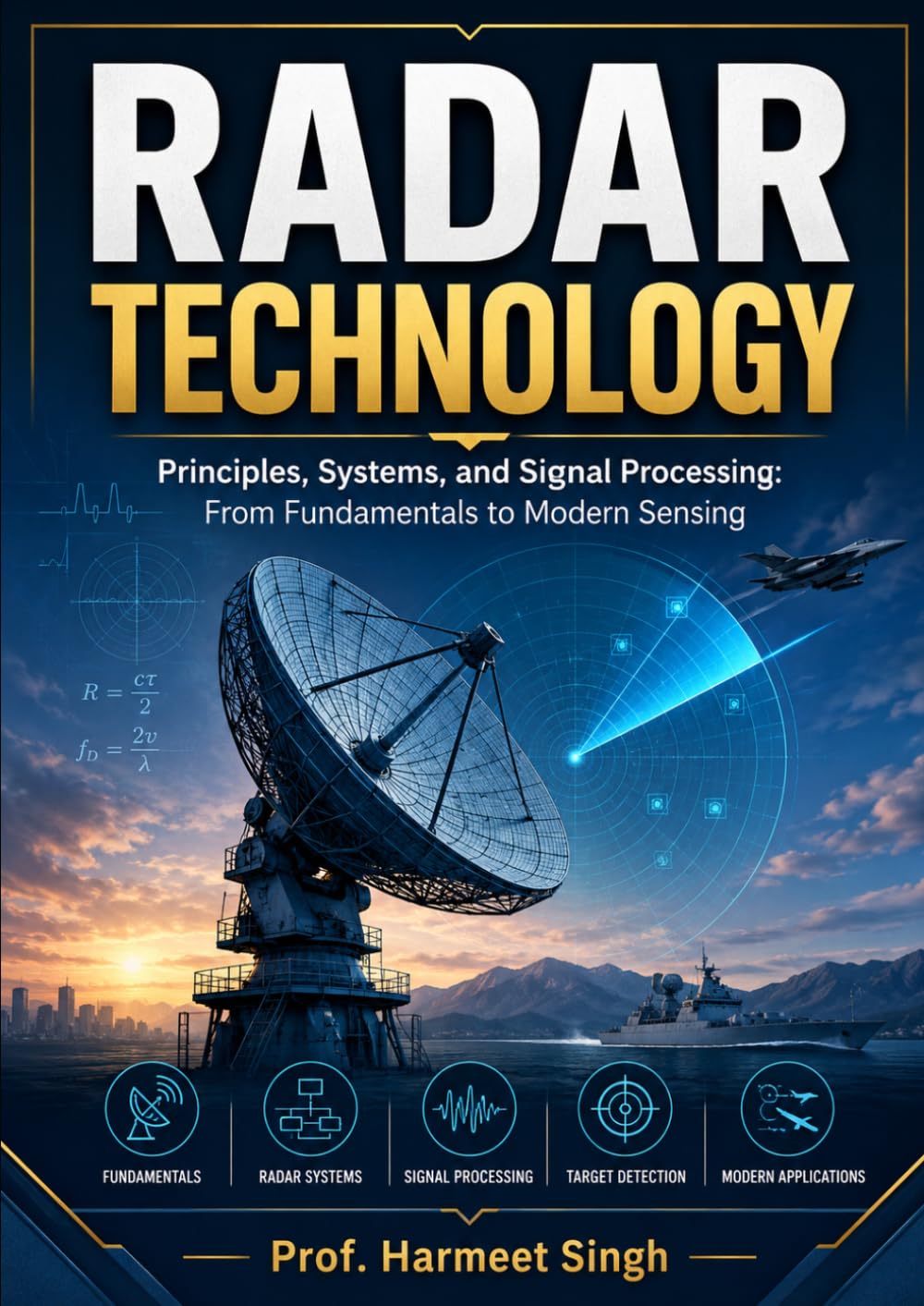

Description
Radar — an acronym born of the phrase radio detection and ranging — is among the most consequential technologies of the twentieth century, and it remains a vibrant, fast-evolving field in the twenty-first. From the coastal warning chains that shaped the outcome of aerial warfare, to the weather systems that guard millions of travelers, to the compact sensors that let an automobile perceive the road ahead, radar has become quietly indispensable. It allows us to see through darkness, fog, cloud, and distance using nothing but the reflection of radio waves — a capability so useful that, once invented, it was never relinquished.
This book is written for the student meeting radar for the first time in a serious way, and for the practicing engineer who wishes to consolidate the foundations. It assumes familiarity with undergraduate electromagnetics, signals and systems, and probability, but develops the specifically radar-oriented ideas from first principles. The guiding philosophy is that a small number of physical insights — the spreading of energy over a sphere, the round-trip delay of an echo, the Doppler shift of a moving target, and the statistics of detection in noise — recur throughout the subject. Master these, and the elaborate machinery of modern radar becomes comprehensible rather than intimidating.
The approach here is deliberately unhurried. Where a result matters, it is motivated physically, stated carefully, and then illustrated with a worked example that puts numbers to the symbols. Radar is a quantitative discipline: a decibel here and a factor of two there decide whether a target is seen or missed, and the reader who works the examples and exercises will come away with the numerical intuition that distinguishes the practitioner from the spectator. Key results are highlighted as they arise so that the central thread is never lost among the details.
The book is organized into nine parts. Part I establishes the foundations — what a radar is, how electromagnetic waves propagate, and how the range equation ties power, range, and detectability together. Part II examines the hardware subsystems, from transmitters and receivers to antennas and the physics of target scattering. Part III develops waveforms and signal processing: continuous-wave and pulsed operation, the matched filter, pulse compression, and the ambiguity function. Parts IV through VI treat detection and estimation, clutter and moving-target processing, and angle measurement and tracking. Part VII surveys the advanced architectures — phased arrays, synthetic aperture, and MIMO — that define contemporary systems. Part VIII reviews the principal application domains, and Part IX looks to emerging directions, from cognitive radar to joint radar-communications and beyond.
ASIN: B0H8LFD75S
VSKU: BVV.B0H8LFD75S.G
Condition: Good
Author/Artist:Singh, Prof Harmeet
Binding: Paperback
Note: Any images shown are stock photographs and product may differ from what is shown.
Condition Notes: The item shows wear from consistent use, but it remains in good condition and works perfectly. All pages and cover are intact including the dust cover, if applicable . Spine may show signs of wear. Pages may include limited notes and highlighting. May NOT include discs, access code or other supplemental materials.