
1
/
of
1
Blue Vase Books
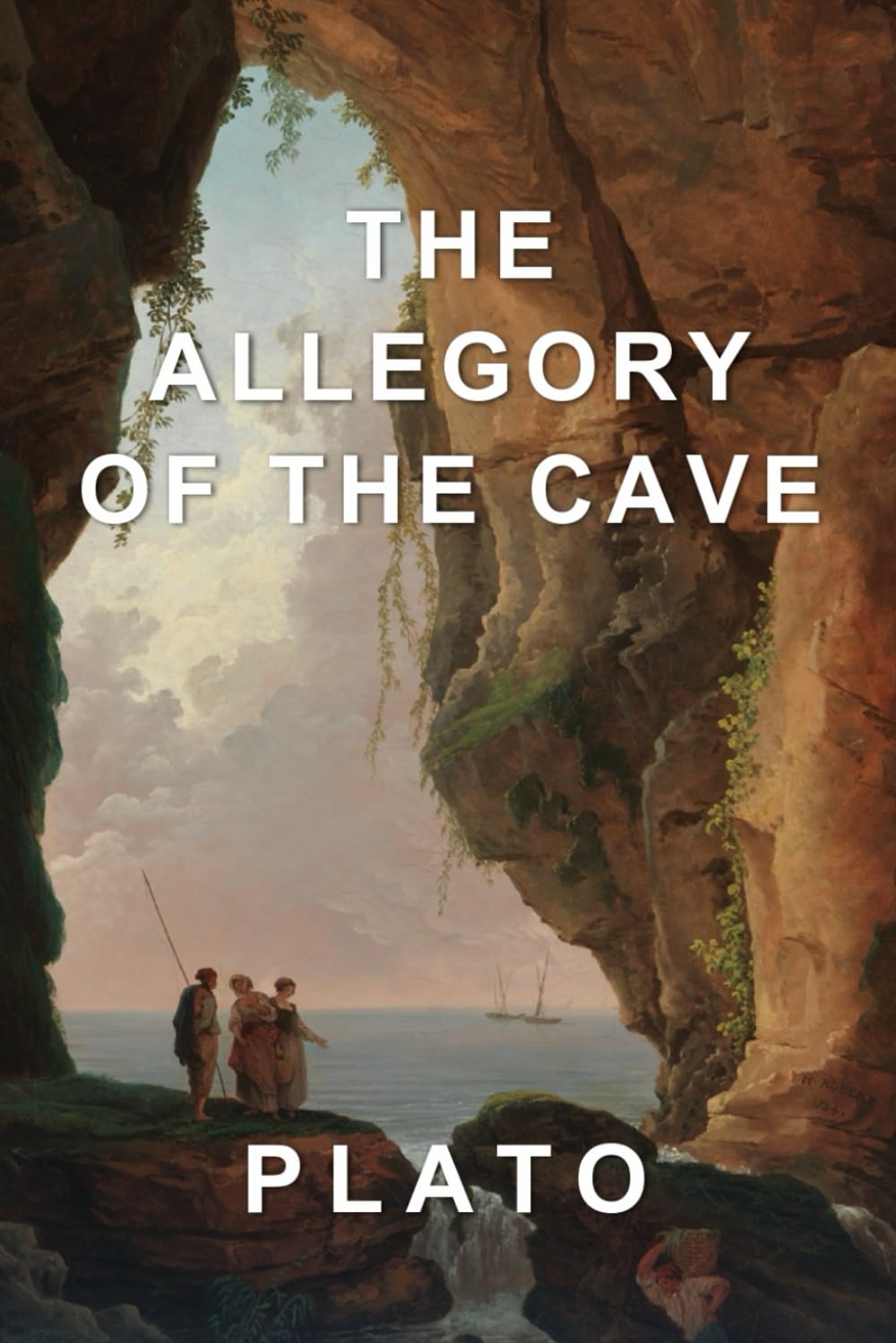
The Allegory of the Cave
The Allegory of the Cave
Regular price
$5.89
Regular price
Sale price
$5.89
Unit price
/
per
In stock
Couldn't load pickup availability
The Allegory of the Cave, or Plato's Cave, was presented by the Greek philosopher Plato in his work Republic (514a–520a) to compare "the effect of education (παιδεία) and the lack of it on our nature". It is written as a dialogue between Plato's brother Glaucon and his mentor Socrates, narrated by the latter. The allegory is presented after the analogy of the sun (508b–509c) and the analogy of the divided line (509d–511e). All three are characterized in relation to dialectic at the end of Books VII and VIII (531d–534e).Plato has Socrates describe a group of people who have lived chained to the wall of a cave all of their lives, facing a blank wall. The people watch shadows projected on the wall from objects passing in front of a fire behind them, and give names to these shadows. The shadows are the prisoners' reality. Socrates explains how the philosopher is like a prisoner who is freed from the cave and comes to understand that the shadows on the wall are not reality at all, for he can perceive the true form of reality rather than the manufactured reality that is the shadows seen by the prisoners. The inmates of this place do not even desire to leave their prison; for they know no better life. The prisoners manage to break their bonds one day, and discover that their reality was not what they thought it was. They discovered the sun, which Plato uses as an analogy for the fire that man cannot see behind. Like the fire that cast light on the walls of the cave, the human condition is forever bound to the impressions that are received through the senses. Even if these interpretations (or, in Kantian terminology, intuitions) are an absurd misrepresentation of reality, we cannot somehow break free from the bonds of our human condition - we cannot free ourselves from phenomenal state just as the prisoners could not free themselves from their chains. If, however, we were to miraculously escape our bondage, we would find a world that we could not understand - the sun is incomprehensible for someone who has never seen it. In other words, we would encounter another "realm", a place incomprehensible because, theoretically, it is the source of a higher reality than the one we have always known; it is the realm of pure Form, pure fact.Socrates remarks that this allegory can be paired with previous writings, namely the analogy of the sun and the analogy of the divided line.
ASIN: 1521777810
VSKU: BVV.1521777810.G
Condition: Good
Author/Artist:Plato|Jowett, Benjamin
Binding: Paperback
Note: Any images shown are stock photographs and product may differ from what is shown.
Condition Notes: The item shows wear from consistent use, but it remains in good condition and works perfectly. All pages and cover are intact including the dust cover, if applicable . Spine may show signs of wear. Pages may include limited notes and highlighting. May NOT include discs, access code or other supplemental materials.
ASIN: 1521777810
VSKU: BVV.1521777810.G
Condition: Good
Author/Artist:Plato|Jowett, Benjamin
Binding: Paperback
Note: Any images shown are stock photographs and product may differ from what is shown.
Condition Notes: The item shows wear from consistent use, but it remains in good condition and works perfectly. All pages and cover are intact including the dust cover, if applicable . Spine may show signs of wear. Pages may include limited notes and highlighting. May NOT include discs, access code or other supplemental materials.
SKU:BVV.1521777810.G
Please Note: Gift cards that are purchased in-store, cannot be used online. These must be used in-store.
Shipping & Local Pick Up
Shipping & Local Pick Up
Shipping: Most orders are shipped within 24 hours. Please allow 4-14 days after the item has shipped for delivery. Faster shipping is available for purchase at checkout.
Local Pick Up: Orders will be available for pick up within 24 hours. Pick up at the front desk Thursday-Sunday 10am-6pm .After hours pick ups are available Monday-Wednesday 7am-3pm at the Shipping & Receiving entrance.